Key Findings
Harassment in Pakistan is a sensitive issue that women prefer not to speak about openly. Academic research can play an important role to skillfully highlight this issue for better visibility and understanding. This research was an attempt towards this goal. On the positive side, all universities in this study have anti-harassment policies. However, women’s stories of harassment reveal that the policies are not implemented in practice. The majority of the victims avoid reporting such cases due to the existing masculine hegemony in the universities. The participants shared that most of the anti-harassment committees are male dominated. Moreover, there are strong male lobbies that protect perpetrators of harassment at all levels of academic and administrative hierarchies. Therefore, such cases take a long time and often end up in favor of the offenders and humiliation of women in the organizations and society at large. Furthermore, victims are also compelled to remain silent by developing organizational pressure and individual threats, where their character is questioned instead of the perpetrators’. As noted, contrary to our expectations, the participants generously shared their stories of harassment in their occupational settings that helped us to understand the intensity of the problem experienced by women leaders in academic organizations. The main themes are discussed below.
Attempts of Harassment by Male Coworkers
Pakistan has a gender-segregated society where women are discouraged to interact with men in public spaces. Women, who are part of men’s networks, are often perceived negatively by the community. However, contrary to such expectations, professional women, particularly leaders are required to communicate with their male colleagues and subordinates to discuss various academic and administrative matters. This study found that the professional relationships between men and women are often misunderstood and misinterpreted by their colleagues due to the existing gender discourses in Pakistani society that don’t distinguish between professional and personal relationships between the two sexes. Such discourses are deeply rooted in the work organizations and men working at different hierarchies take advantage of these cultural settings and attempt to harass their women colleagues, subordinates, and managers as well. The findings indicate the prevalence of harassment by coworkers in the form of demeaning jokes and comments including sexual remarks. The following excerpts evidence this:
I often receive impertinent statements, for instance, once after an official meeting, one of the fellow committee members commented about my stance that “Madam, ap ny to kamal hi kr dia, ap to hain hi kmal ki” (Translation: Madam you have discussed your point in an amazing way, as you are an amazing woman yourself). The way he communicated the sentence in a sexist way, was alarming for me. (Participant A).
Since my early professional life, I frequently receive sexual jokes and text messages on my cellphone from anonymous contacts. However, I believe that they are mostly my male colleagues, subordinates, and students. (Participant B).
Participant B also shared her experience during an interdisciplinary conference, when a male colleague commented on her style and speech in a sexist tone i.e. “mam, ap bohat khoob bolti hain, hum to sunty hi reh gy” (Translation: Madam, you speak so beautifully, we kept listening to your beautiful words). The English translation of these sentences may not be conveying the intensity of the words; yet, spoken in the local language i.e. Urdu, these are sexist and demeaning words, especially when it is used by highly educated people in academia. The excerpt shows that instead of giving remarks on the academic strength and value of the participant’s work, the men discussed her feminine style, which she found offensive and disappointing. They believed that such comments stigmatize women leaders’ image and influence their career choices. It is clear from the narratives of the participants that men, who are the products of patriarchy, are motivated by the dominant masculine culture to control women through inappropriate remarks.
The findings show that all unmarried women (6) among the total participants (23) in the larger study, experienced some sort of harassment. It unveils the existing vulnerability of unmarried women in academic organizations. In Pakistani society, family and marriage are considered as the primary concerns of women; therefore, career-oriented women are often stigmatized by their family and community and considered as deviant. At workplaces, males often take advantage of their single status and attempt to harass them verbally or no-verbally, for instance, passing sexual comments and jokes, grabbing, touching etc. Many single women have shared their experiences of harassment within the organizational settings that is clear from the following statements:
I take good care of my skin and maintain formal attire. For instance, I use nail paints frequently, and my nails remain well-shaped and grown. Once, an elder male colleague gave a statement, when I was typing a letter, “ab ma ap kay hath dekhon ya ap ka kam” (Translation: Should I concentrate on your typing or your beautiful hands). I carefully responded that “inhi khobsorat hatoon sy ma thapar bhi bohat achaa maar skti hon” (Translation: With these beautiful hands, I can also slap hard). (Participant C).
Single women are perceived as weaker and sympathetic in contrast to married women in Pakistani society. This example and others highlight that women are well-aware of existing stigmatization by hegemonic men. Therefore, they remain careful while interacting with their male counterparts and are ready to resist and respond to the stigmatization. Moreover, they have come of age and have acquired the courage and confidence over time to deal with the perpetrators. Such behavior on the part of these women sets examples for other women to defy the cultural norms of obedience and silence, and instead encourages them to stand up for themselves. It also conveys a message to men that women are not freely available subjects, who can be used for pleasure. Ultimately this could lead to a more gender-balanced workspaces that are free from harassment and stigmatization.
I believe that men have a typical perception of a woman interacting with them; therefore, I remain cautious. For instance, if I accept their offer for a cup of tea in their office, they usually take it as a signal for a relationship. In addition, if I spend another tea break with them that is often completely misinterpreted as they start trying to cross the limits such as they start discussing my personal life i.e. marriage, style of dressing and nail paints etc. (Participant D).
The participants reported that male colleagues take advantage of their age in their harassment. The age discourse in Pakistani society offers more respect, prestige, and power toward the elders. In particular, elder men are more influential due the prevalent patriarchal normative structure. Therefore, regardless of the authority vested in the administrative positions, women leaders are bound to give additional respect and compensation to the elder men at work. It allows them to control women through the acts of harassment. The participants reported that most men, especially at the lower levels of hierarchy, are elders; hence, they criticize women at the positions of power and often refuse to follow their instructions.
Harassment by Senior Executives
Leadership endeavors new and interesting opportunities for individuals, and communication with senior administrators is one of them. However, women leaders experience additional challenges besides good opportunities. In this study, participants highlighted that in many cases the harassers were men at senior leadership positions, who were unwilling to see women competing with them equally. They used harassment as an instrument to downplay and harm women. A departmental chairperson expressed the issue of top-down harassment in this way:
I believe that top management has a powerful role in developing organizational culture. In board meetings, top management often ignores women’s opinions and use impertinent and undignified language for them such as using the word ‘bibi’ (a typical Urdu word used for women in the traditional sense) instead of using their title ‘Doctor’, ‘Ms.’ or ‘Madam’ as it is in the case of men. I consider it as sexual harassment because it hurts my gender identity (Participant E).
In the Urdu language, there is difference in addressing someone respectfully and casually. For women, slang words and discourteous language are often used; while for men, respectful words are preferred. This was experienced by majority of the participants, and they considered it as a form of harassment. Examples of such words are compared and contrasted in Table 2, below.
Table 2: Slang and Discourteous Words Used for Women in Contrast to Men in Pakistani Societ
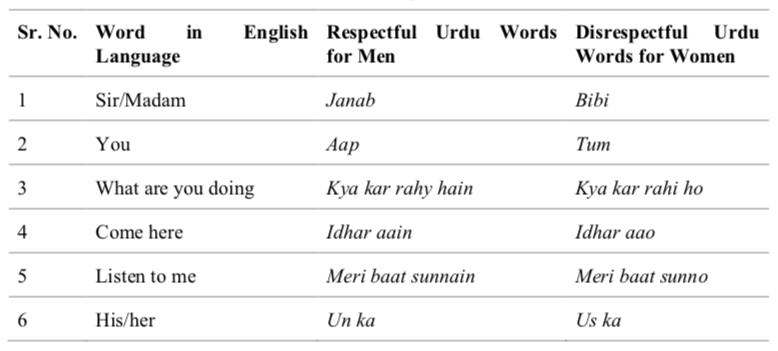
Source: Interviews with the Participants
These discourses highlight men’s traditional approach to suppress women, who intend to compete with them for senior leadership positions. This also evidences that education and professional work do not necessarily bring any behavioral changes in men. Likewise, another participant narrated:
I feel that the senior executives are aware of my credibility; therefore, they often attempt to harass me on different occasions to confine my professional growth. Such as, once a senior executive directly offered me promotion upon accepting his unethical demands and giving my consent for working with his nominated team. I refused the offer straight away. (Participant F).
This excerpt unfolds a harsh reality in academia that women leaders are constantly victimized by the top hierarchy. Strong and confident women are also sexually harassed. Men take advantage of their authority to suppress women’s professional growth and maintain their hegemony. Language is utilized as a major tool by these men to disseminate these discourses among women in the workplace. Women are not allowed to speak up loudly during formal interactions, while men often act violently by utilizing impertinent verbal and no-verbal expressions.
Harassment from the Junior Staff and Subordinates
The data also revealsthe harassment of women leaders by their subordinates in universities. The majority of the administrative personals include men, who have strong lobbies. Since society gives them autonomy to exploit women by various means including harassment, these individuals recreate the same space in their workplace. It is evident that harassment by subordinates is more common against single women, who are an easy target for these men as discussed in the previous theme. The participants expressed multiple obstacles in dealing with their subordinates, especially those who were old in age. A single woman explained her experience in this way:
I often observe that the body language and expressions of the male staff are quite offensive. They know about my single marital status; therefore, they often crack sexual jokes and comments during meetings or start convincing me for marriage. I feel that they use it as a tool to suppress me and create pressure. (Participant D)
The above narrative illustrates the power of men towards women irrespective of their occupational positions and social status. Clearly, hegemonic cultural norms empower men to defy women in powerful positions. They consider it as an offense to be governed by women; hence, they retaliate in the forms of harassment. Moreover, these women have less family and community support; therefore, men try to suppress them quickly by their typical behavior and body language. Another unmarried participant reported:
Harassment is common by men from high to low occupational statuses. Once, in the car parking, a young male clerk pretending to be on his phone, commented on me; “yar tum ho hi bohhot achi” (Translation: Dear you are so sweet). The very next day, the same man commented the same in the parking. I was vigilant, so I stopped and asked him to whom he was talking but he cleverly denied. A few days later, he attempted for the third time, so I reacted in a bit harsh tone. I suddenly stopped him, asked for his employment card, and threatened to report to the security officer. Moreover, I informed the case to his reporting officer, who issued him a warning a letter. Since then, he has never affronted me. (Participant C).
In sum, masculine discourse is strongly embedded in academia and provokes men to harass women. Women are generally perceived through their feminine identities and often stigmatized. This discursive construction of gender identity adversely influences women’s personal as well as professional lives. Unmarried women experience adverse effects due to these hegemonic cultural norms. The status of a single woman, including strong, confident women, is perceived by these men as an available status. Therefore, single women leaders remain more careful and interact with their male peers within definite boundaries to avoid sexual violence and stigmatization.
Dealing with Harassment in Leadership Pathways
The findings of this study reveal that all universities have developed anti-harassment policies, and specific committees are also constituted to address the issues of harassment and provide justice to the victims. However, the results reveal that the majority of members in these committees are men, who are biased against women. They show no sympathy towards women and discourage complaints related to harassment as they believe this is damaging for the reputation of the universities and men themselves. This clearly shows that the dominant masculine discourses legitimize and defend the acts of sexual harassment at the workplace. Harassment thus becomes ‘normal’ business in the daily lives of women, which they silently endure. Women in leadership positions are well aware of this normalization of harassment and the consequence of reporting it. Hence, they remain vigilant about how they perform in their workspaces. They also employ numerous strategies to encounter the harasser. The following excerpts evidence this:
Being women, we need to be vigilant while communicating with men, because they don’t hesitate to cross the limit and try to dominate in all aspects. Therefore, while interacting with men, I maintain a good distance, behave in a well-controlled manner, and hold a slightly harsh tone. I find it quite effective for dealing with the harassers. (Participant B). I don’t keep myself segregated from men but communicate within culturally defined limitations. For instance, I follow the traditional dress code and maintain a slightly harsh, rude, and loud voice during interaction with men to avoid any misbehavior. (Participant G).
I never consider my feminine identity as an obstacle in my professional life. I behave professionally; therefore, I firmly respond to perpetrators. Such as, I use the words “app is qabil nhi hain k ap k saath baat kee jay” (Translation: You do not deserve to have a chat with me), and this often brings positive outcomes or “apni had ma rahian” (Translation: Keep yourself in the limits) etc. (Participant F)
The above illustrations show the unique strategies of women in dealing with the harassers. Women holding leadership positions require frequent interaction with men colleagues and sometimes even minor neglect of their vigilance allow men to cross the limits. Thus, women remain very careful while interacting with men. Any open and friendly attitude by women with men in the workplace is often negatively perceived in academia.
Moreover, the participants argued that women should raise their voices against all kinds of violence and discrimination. To do this, they need to be strong and confident and avoid disclosing their weaknesses to others. The participants believed that young and unmarried women find it difficult to deal with the attempts of harassment, and often feel insecure and hesitant to disclose such events. They react with uncertainly due to existing stigmatization. For instance, participant C shared that if a woman comes forward to resist any kind of violence or discrimination, she receives humiliating statements, such as “yeah aurat ghunda gardi kar rhi ha” (Translation: This woman is bullying) or “yeah na hanjar ha” (Translation: She is a crusty irascible cantankerous woman). Consequently, men become more powerful and frequently use harassment as a tool to control young women and restrict their professional growth. Most of the women learn to deal with attempts of harassment through personal experiences and constant exposure to the new and challenging academic and administrative environment.
Table of Contents
- Introduction
- Theoretical Framework
- Literature Review
- Methodology
- Key Findings
- Discussion
- Conclusions and Implications
- References