Methodology
Study Design
The methodological foundation of this qualitative investigation is embedded in the postmodernist theoretical stance that views reality as a subjective phenomenon (Creswell, 2014). Hence, we have taken an interpretive and constructivist approach that permitted us to develop careful insights into the issues of sexual harassment in the academic administration in Pakistani universities.
Locale and Population
This paper is drawn from the doctoral thesis of the first author that documented women’s experiences of academic administration in Pakistani Universities. The populations of women working as academic administrators in co-educational universities, registered in the general category by the Higher Education Commission [HEC], were chosen from two cities of Pakistan: Islamabad and Rawalpindi. Limiting this study to coeducational universities allowed us to explore the prevalent power relations in the academic administration because these institutes represent a distinct professional culture that is highly influenced by the dominant masculine discourses (Khokhar, 2018).
Sample
Purposive sampling was employed to select the prospective participants in this study. Women’s availability and willingness were equally considered during the entire sampling process (Robinson, 2014). Our sampling criteria included women (a) having Ph.D. degrees (b) designated as professors i.e. Assistant Professor, Associate Professor, and Full Professor (c) presently occupying any academic leadership position i.e. Dean or Department Chair and (d) having a minimum one-year academic leadership experience in Higher Education. Surprisingly, no woman held the position of Vice-Chancellor in the target population.
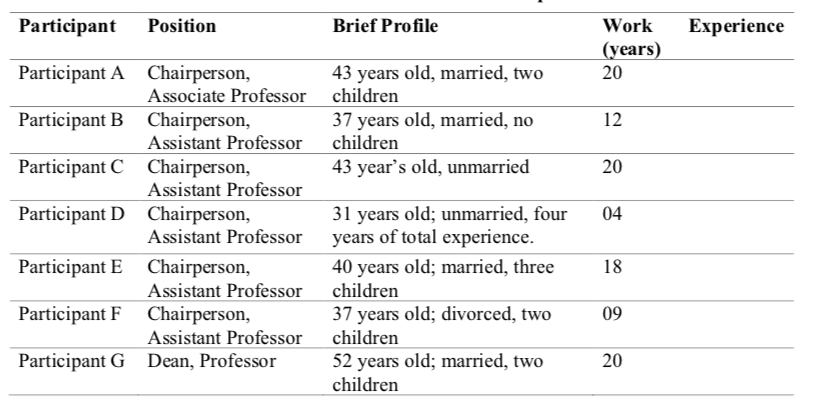
Although twenty-three women leaders were included in the sample for the larger study; in this paper, we have included the narratives of seven women who had shared their experiences of harassment in a nuanced way. A brief profile of these participants is given in table 1.
Table 1: A Brief Profile of the Participants
Source: Interviews with the Participants
The above table summarizes the characteristics of the sample in this study. It shows the diversity of participants in terms of age and marital status. The data highlights that age and marital status influence the exposure of women toward sexual harassment at workplace which is discussed in the findings in detail. Moreover, among these seven participants, there was only one dean and six were departmental chairpersons. Furthermore, they had been in a leadership position for two to nine years and had vast teaching experience in higher education.
Data Collection
The data was collected in the summer of 2019 through in-depth interviews. The interview guide included a range of preliminary questions about participants’ demographic backgrounds such as age, education, designation, marital status, etc. It was followed by more specific and indepth inquiries about sexual harassment in the workplace i.e. types of harassment, perpetrators of sexual harassment in the occupational hierarchy, and women’s strategies to confront such issues and to pursue their career trajectories.
In the absence of a gender-specific database about university employees, we relied on universities’ official websites to locate our participants and made personal visits where the website information was outdated or incorrect. All participants were invited to participate in the study by sending an e-mail to their official accounts.
The interviews took place in the offices of women leaders as per their convenience. Audio recorders were used during interviews after obtaining informed consent from the participants. While field notes were also taken to jot down important observations during the interview process. Beyond our expectations, the participants were quite enthusiastic to participate in the study and shared their varied leadership experiences, particularly about harassment—a very sensitive issue, and women in Pakistan generally hesitate to discuss it openly. Since the participants had personal experiences to relate with the research questions and some of them were also interested in researching women’s issues, they were keen to contribute to the study and extended all possible support in data collection. Despite their busy office routines, they gave quality time for the interviews that helped the researchers in understanding the phenomenon more comprehensively. Also, since the researchers too work in universities, building a relationship of trust was not a challenge, and the participants openly shared personal stories that helped to generate rich data. However, some women denied participation in the study. They did not have personal reservation but due to the time constraint and overwhelming official commitments, they were unable to do so.
Data Analysis
Foucault’s discourse analysis guided the entire process of data interpretation and analysis to pinpoint not only prevailing masculine discourses but also women’s subjectivities and underrepresentation. Interviews were conducted in both English as well as Urdu languages. All interviews were conducted and transcribed by the first researcher. Later, the Urdu transcripts were carefully translated into English and counterchecked by a language expert to ensure the cultural significance of each word being translated. Subsequently, close reading and re-reading of the transcripts were undertaken to access consistency that resulted in the emergence of various relevant discursive codes and themes.
Ethical considerations and Trustworthiness
The study also incorporated ethical principles to protect the rights of all stakeholders (Hammersley, 2015). Confidentiality of the data was ensured by keeping an anonymous record of all stakeholders. Pseudonyms were assigned to all participants to maintain confidentiality. Furthermore, written informed consent was taken for their voluntary participation in the study. The participants were given a right to stop the interview or withdraw any question that they found unethical. Moreover, we utilized Creswell’s (2014) principles to ensure validity and trustworthiness that include member checking, peer debriefing, and controlling personal bias and observation.
Table of Contents
- Introduction
- Theoretical Framework
- Literature Review
- Methodology
- Key Findings
- Discussion
- Conclusions and Implications
- References